‘Massive plane' carrying great deal of cargo
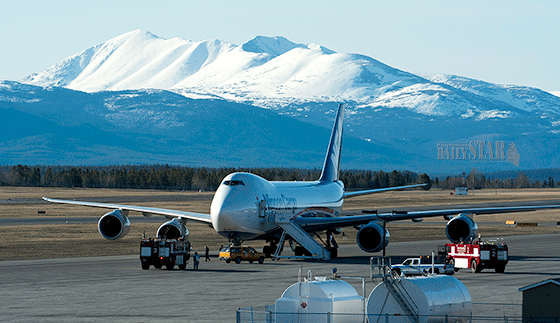
A Japanese Boeing 747 cargo plane was forced to make an emergency landing in Whitehorse this morning.
By Chuck Tobin on May 23, 2013
A Japanese Boeing 747 cargo plane was forced to make an emergency landing in Whitehorse this morning.
"There was an indicator in the cockpit that said there may be a fire in the lower cargo hold,” regional president Shawn McWhorter of Nippon Cargo Airlines told the Star from the company's North American headquarters in Chicago.
"After they landed, it was determined it was a false indicator and there was no emergency.”
McWhorter said a Nippon Cargo maintenance crew was being dispatched to Whitehorse from either Anchorage or Chicago to double-check the aircraft before it departs.
It's likely to be parked at the Erik Nielsen Whitehorse International Airport for at least a day, he said.
"Right now the emergency is over, and we do not believe there was any problem, but we are always going to err on the side of safety.”
McWhorter said the crew of five was already headed to local hotel.
"Take good care of them up there,” he urged.
He said the fully-loaded 747 had departed the John F. Kennedy Airport in New York and was en route to Anchorage to fuel up for the second leg of the trip to Tokyo.
Airport spokeswoman Jennifer Gemhair said the Nav Canada centre in Whitehorse was contacted at 7:10 by the Nippon Cargo aircraft declaring an emergency.
"It was determined that the Whitehorse Erik Nielsen International Airport was the closest airport for a safe landing,” she said.
Gemhair said Nav Canada contacted local airport authorities who in turn activated the emergency co-ordination centre at 7:20.
"The airport emergency fire crews responded immediately and were on scene for the touchdown at 7:29,” she said.
"The aircraft landed safely without incident, and all five crew members disembarked the plane with no injuries.”
In addition to the airport fire crews and their two foam trucks, Gemhair said, city firefighters responded and were on scene when the 747 landed.
Whitehorse platoon chief Barry Blisner said pumper truck number two and tanker one responded from Station #2 on Two Mile Hill and the rescue truck came up from Station #1 downtown, with about 10 firefighters in all.
In these situations, he said, the airport firefighters are in command. The city crews are there largely to provide support and ensure they have enough water for their trucks if they need it.
It was airport fire chief Doug Burgis and his crew who went through the aircraft – fully suited, with air tanks on – to double-check the cargo bay and make sure there was no fire, he said.
"They went through it a number of times,” he said. "They worked their tail off.
"They did a pretty good job. That is a massive plane, and it had a lot of cargo on it.”
Blisner said he spoke with the pilot, who told him they were about 145 kilometres (90 miles) past Whitehorse when the indicator went off and forced them to turn around.
The fire crews were on the scene until shortly after 12 p.m., he said.
Trudy Wassel of the Ted Stevens Anchorage International Airport said today Anchorage handles about 500 international cargo flights a week, down from about 700 prior to the 2008 economic downturn.
"We're 9 1/2 hours from 90 per cent of the industrial world,” said the airport's manager of operations. "A lot of the carriers will come through here, and we call it a gas-and-go.”
"They can carry more cargo and less fuel to come to Anchorage and then carry on to the lower 48 to deliver their goods,” she said.
"We call that the payload equation, and that is a big advantage for our carriers and out location here.”
Wassel said flight 158 from J.F.K. did notify the Anchorage tower that it was diverting to Whitehorse.
She said back in the day Anchorage was handling up to 100 wide-body cargo aircraft like the 747 every day.
Gehmair said the Whitehorse runway is 2,896 metres (9,500 ft) in length, and 46 metres (150 feet) wide.
It is large enough to handle regular scheduled Code D traffic, which includes aircraft up to the size of a Boeing 767, but not large enough for regularly scheduled 747 traffic, she said.
Gehmair said the airport is large enough to handle emergency landings of 747s and other aircraft in that class.
The last time an emergency of this sort was declared was on Sept. 11, 2001 – 911, she said, when officials initially feared a Korean Airlines jet had been hijacked to the Yukon capital.
That aircraft, which landed safely, had not been hijacked.
Be the first to comment