Photo by Vince Fedoroff
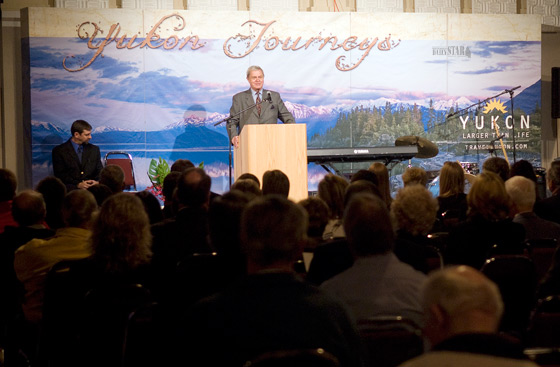
TRIBUTE TO A FRIEND - Rolf Hougen, a friend of Erik Nielsen's for more than 50 years, addresses Saturday afternoon's memorial service.
Photo by Vince Fedoroff
TRIBUTE TO A FRIEND - Rolf Hougen, a friend of Erik Nielsen's for more than 50 years, addresses Saturday afternoon's memorial service.
Most of what has been written about Erik Nielsen since his death last month, and also during his life, has centred around his career as a politician.
Most of what has been written about Erik Nielsen since his death last month, and also during his life, has centred around his career as a politician.
No doubt this is because there is much to write about his years representing the Yukon in Ottawa, but also because, as his son Rick says, "Dad was essentially a very private person."
In spite of the fact that Nielsen may have balked at such an outpouring of love and respect on his behalf, more than 200 of his family members, friends and colleagues gathered together Saturday afternoon to give a final farewell to the man known as Yukon Erik.
Nielsen, who served as the territory's MP from 1957 to 1987, died of a massive heart attack at the age of 83 in Kelowna, B.C.
At the memorial service honouring his life, held at the Yukon Convention Centre, Nielsen was remembered not only as a decorated Second World War pilot or as the political dynamo who drove the effort to enfranchise Canada's first nations people, but as a deeply loved father and grandfather.
The people who filled the convention centre were given a rare glance into the personal side of Nielsen's life.
Tables laden with photos and mementos ringed the huge room, with holiday snaps standing side-by-side with newspaper clippings and election ballots; the public record of his years of service to Yukon and the nation.
Born in Saskatchewan in 1924, Nielsen began serving his country when he was just a teenager. He flew 56 missions during the Second World War, including the D-Day mission, as a Royal Canadian Air Force pilot and was awarded the Distinguished Flying Cross. The photos of young Erik show a fresh-faced man, looking both carefree and proud in his RCAF uniform.
He was perhaps a superstitious man, as evidenced by the fact that, for more than 50 years, he carefully preserved two pieces of shrapnel which flew through his aircraft and lodged in his uniform during one mission. But if he kept mementos of the war, he did not allow himself to be clouded by the memory of fallen comrades.
His second son, Rick, recalled flipping through the meticulous flight log Nielsen kept during those missions and asking his father what it meant when an entry was circled in red pen.
"He told me on these days, he lost crew members. No reference to names or details, just perfunctory red circles."
These were not the marks of an unfeeling man, his son asserted. Rather, they are evidence of Nielsen's pragmatism and his understanding at a very early age that it is better to prepare for the next battle than it is to mourn the losses of the last.
"I think my father's disciplined, matter-of-fact approach to the rest of his life was largely fashioned from those wartime experiences," Rick said.
And it was just this disciplined approach to life that Nielsen brought with him when, as a newly-minted lawyer, he arrived in the Yukon in 1952.
Rolf Hougen, a friend of more than half a century, recalled that when Nielsen stepped off the plane in Whitehorse, he was dressed as any self-respecting young Englishman would be in those days.
But his formal suit and black hamburg produced such laughter in the hinterland that he quickly abandoned both and instead identified himself by the fervent belief in democracy and equality that he espoused throughout his political career.
"Erik Nielsen changed the history of Yukon, he changed the history of Canada and he changed it for the better."
Those words, from former prime minister Joe Clark, delivered in a prerecorded speech, were echoed time and time again as people from all over the territory stood to honour Nielsen as a champion of aboriginal people and of territorial independence.
Nielsen was the first politician ever to visit the far-flung community of Old Crow. Kathie Nukon, a member of the community's band council, was just 10 years old when he arrived, but she vividly remembers what he had with him.
"Erik brought a ballot box to Old Crow to tell the people about the voting process," said Nukon, who was Yukon Conservative MLA in the early 1980s.
"He let the people of Old Crow know of their democratic right to vote.
"When Erik spoke to the people of Old Crow, they listened and they always voted for Erik."
Nielsen's reputation as a man who never spilled a political secret earned him the name "Velcro Lips" both in Parliament and in the media. But in his home riding, he was not above turning a potentially embarrassing question into a hilarious response.
Ken McKinnon, who served as Commissioner of the Yukon from 1986 to 1995, remembered Nielsen as a politician who was not afraid to make himself the brunt of a good joke.
He recalled that during one of Nielsen's many campaigns, a group of young Liberals had changed a sign that originally read: Erik, to: Erik Pees in the Bath.
Instead of giving the indignant response we have come to expect from today's brand of politician, Nielsen shot back with equal irreverence.
"My opponents are not being truthful," McKinnon recalled him saying when asked about the defaced sign.
"The truth of the matter is, I do not take baths, I take showers. Ergo, I pee in the shower."
For all his years of public service, Nielsen was most proudly remembered by Rick and two grandsons, Erik Temple and Connor Nielsen.
The two young men told of idyllic summers spent listening to their grandfather's war stories, debating and fishing.
And although he may never have seen his grandfather duking it out in the House of Commons, it was Connor who best described the late MP's skill as a debater.
"He was constantly reading and researching to further his knowledge in every area he could," Connor said.
"I found out quickly that his ability to argue and debate was unmatched. It didn't matter if I thought I had every statistic, reference and fact available on my side; he would still find a way to blow holes in my logic.
"He would never back down from a challenge and would defend his beliefs with a passion .... He was and always will be a huge source of courage for me."
"Dad loved flying," recalled Rick. "I think he saw it as the quintessential personification of freedom.
"Make no mistake about the importance of freedom in my dad's life. It was his life's work. It started with his wartime service safeguarding the right of people of the free world to remain just that: free.
"It manifested itself later in his education as a lawyer, his love and respect of the law and the basic rights of all Canadians, including Canadian Indian people, who for a time could only vote in elections by collectively forfeiting their rights, titles and interests as indians."
With that love of flying and legacy of freedom in mind, Nielsen's family and many of his former friends and colleagues are lobbying to have the Whitehorse International Airport renamed in his honour.
After the speakers had finished, the family presented a slide show depicting Nielsen's long life.
Earlier, the family held a service for Nielsen in Kelowna, where he had lived with Shelley, his wife of 25 years. She attended Saturday's memorial.
On Sunday, family members planned to scatter his ashes at his beloved retreat at Quiet Lake.
In order to encourage thoughtful and responsible discussion, website comments will not be visible until a moderator approves them. Please add comments judiciously and refrain from maligning any individual or institution. Read about our user comment and privacy policies.
Your name and email address are required before your comment is posted. Otherwise, your comment will not be posted.
Be the first to comment